
SPALECK ActiveFEED optimises sorting quality, plant performance and process control
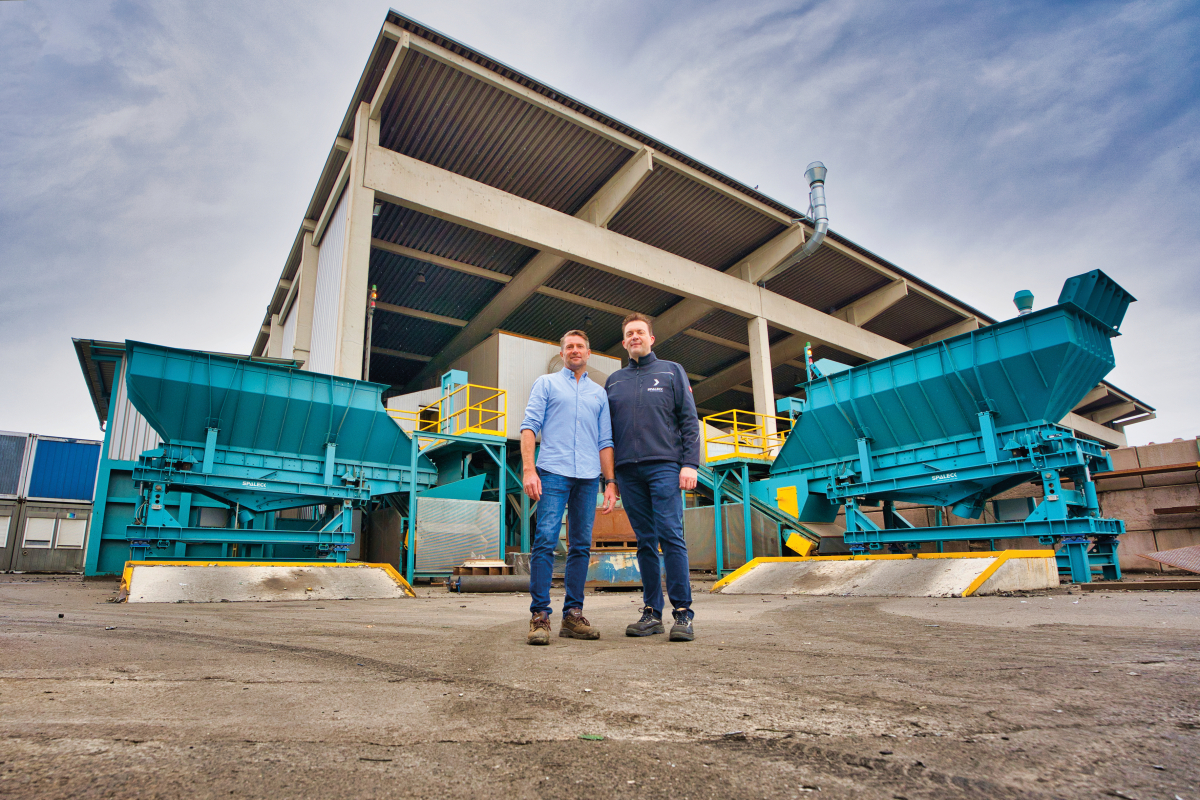


Iwan Koslow GmbH & Co. KG operates the largest of its four recycling sites in Bavaria, situated directly on the A92 motorway. With around 150 employees, the family-run business has been successfully holding its own against the competition for more than 75 years as a processor and recycler of secondary metal raw materials. Michael Kannengießer, project manager at Koslow, explains: “Our customers – metal smelters and foundries around the world – place the greatest and ever-increasing emphasis on the purity of materials, competitive purchase prices and a highly reliable supply of materials when selecting their suppliers. Any metal recycler who wants to be successful in the long term must have complete control over its entire recovery process.”
Koslow is a metal recycler with a wide range of products. Every year, the company processes more than 180 000 t of metals. These include, in particular, end-of-life vehicles, scrap iron, shredder light and heavy fractions, and electrical and electronic waste in categories 4 and 5.
“Our job is to produce consistently high-quality sorted metals and metal concentrates from a wide range of different input materials. In our view, it is not enough simply to optimise the sorting process itself. There is no benefit in investing millions in high-quality sorting technology if the upstream processes are not working reliably,” says Kannengießer. The key, he explains, is the optimal interaction between all process steps.
First major lever: optimal screening quality
The collaboration between Koslow and the screening specialist SPALECK began back in 2013. At that time, it was the screening process – or, more precisely, the insufficient screening quality – that led the company to SPALECK in Bocholt.
“We had reached a point where we could no longer improve our sorting quality any further. The screening technology used at the time – a trommel screen – did deliver the required throughput, but the screening quality was very poor. Despite various adjustments to the trommel, many long pieces and large amounts of fine material continued to end up in the target fraction for our sorting equipment,” recalls Kannengießer.
Comprehensive screening tests with Koslow’s different input materials at the SPALECK TestCenter finally provided the solution.
Christian Lake, Sales Manager at SPALECK and still the contact person for the Bavarian recycling company, reports: “I still remember very well how we were able to create real added value by optimising the screening process at Koslow.”
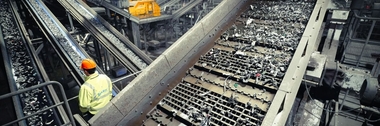
Following the successful testing, Koslow decided to replace the outdated trommel screen with a SPALECK screening machine specially optimised for metal recycling. This was the basis for a significantly higher sorting quality.
“The SPALECK screening machine continues to deliver very precise grain sizes to this day. With virtually no cleaning required, it produces exactly the screen cuts that our sorting equipment needs. Furthermore, long pieces are reliably separated out thanks to the 3D screening technology,” reports Kannengießer. “The screening process has shown us just how much of an impact the upstream process steps have on the final material quality.”
Simply by optimising the screening technology, Koslow was able to increase the quantity of non-ferrous metals recovered – depending on the specific input material – by between 11 - 13 %.
What is probably the most overlooked process step becomes the most important: the ActiveFEED
Until a few years ago, infeed hoppers were among the components of a processing plant that were rarely discussed when it came to optimising sorting quality. Their role seemed clear: to receive material, buffer it and pass it on to the following technology.
At Koslow, too, the existing infeed hopper fulfilled precisely this function – at least as long as the material flowed without problems.
“Regardless of the input material, we experienced blockages several times a day that had to be removed manually. Either the material supply was interrupted and our sorting machines ran empty, or too much material was fed in at once, causing the sorting machines to be overloaded. This affected both the sorting quality and the sorting result,” says Michael Kannengießer, describing the situation at the time.
“We asked ourselves why we invest enormous effort in achieving optimal results at the end of the sorting process, whilst at the same time accepting significant fluctuations in the material feed.”
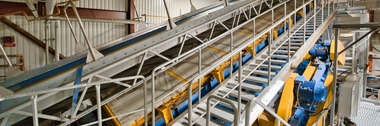
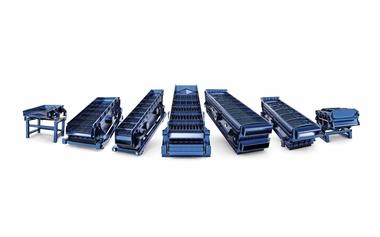
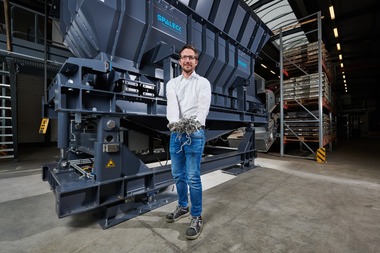
The solution came, quite literally, at the touch of a button: the SPALECK ActiveFEED infeed hopper. This intelligent feeding technology was developed by SPALECK in collaboration with metal recyclers in 2019 and, due to the pandemic, was unveiled for the first time at IFAT 2022. At this year’s IFAT in Munich, the specialist in conveying and separation technology presented the latest generation of the ActiveFEED as a high-performance feeding solution for sorting equipment such as eddy current separators, X-ray sorters and LIBS systems.
Christian Lake explains: “The ActiveFEED represents a completely new generation of material feeding. It enables plant operators to adjust the performance of their sorting equipment to the type of material at the touch of a button. The sorting machine receives its input material at the optimum layer height and width, at the correct speed and always in exactly the required quantity – fully automatically.”
Why Michael Kannengießer thinks of his grandmother’s cake
To illustrate the ActiveFEED’s "BEST INFEED" principle, Kannengießer likes to use a comparison that, at first glance, seems to have little to do with sorting quality. “To me, the material feed with the ActiveFEED is comparable to my grandmother’s cake recipe. You can tell straight away if an ingredient is missing, the preparation isn’t right or the necessary experience is lacking.
Thanks to the ActiveFEED, we can now deliver the same first-class sorting quality to our customers at all times – without blockages, without downtime and without being dependent on the individual experience of the plant staff. The ActiveFEED boosts our productivity and our sorting quality. In doing so, it uses the experience we have gained over almost eight decades of metal recycling. And that is exactly what our customers ‘taste’ when they buy Zurik fractions, copper fractions or single-grade aluminium from us,” explains Kannengießer.
The plant operator gains full control over the process
The optimised material feed also changes the role of the plant operator. Previously, it was possible to determine at the end of a shift how many tonnes had been produced. However, it was often only possible to speculate as to why some shifts achieved better results than others.
“The great thing about ActiveFEED is that we can adjust the throughput precisely and continuously. Blockages practically no longer occur. Our sorting machines operate at their economic optimum and produce the highest possible quality – and, most importantly, a quality that we can control precisely,” explains Kannengießer.
At the same time, plant management has a clear, real-time overview – through data analysis – of which production output is being produced and when. This makes it easy to compare shifts and meet production targets.
Thanks to the precise controlled material feed – optimised for the specific input material and its sorting machine – the plant operator can manage their sorting technology very cost-effectively. Production costs are reduced, whilst each sorting line delivers precisely identical results.
“If we need the material in ‘ready-to-melt’ quality, we can be sure of achieving this result on the very first run with ActiveFEED. This allows us to eliminate the need for additional rework. Manual sorting is reduced to a minimum or eliminated entirely. At the same time, we avoid the need for time-consuming adjustments to the sorting technology.
As a result, we not only sell pure fractions but also offer our customers the highest level of reliability and predictability. In this way, new business relationships quickly develop into long-term partnerships for us.”
Another advantage for Kannengießer: “Work has become easier not only for us as plant operators, but also for our production staff. Our team now actively uses the time previously lost to blockages or material fluctuations for quality optimisation, plant monitoring, cleaning or even maintenance. No one has to worry any longer that the line will run unevenly or that fluctuations in output will occur.”
2026: Eight ActiveFEEDs now in operation
Anyone visiting the Koslow site today will see eight ActiveFEEDs now in operation. “The advantages of the system are so great, and the organisational and economic benefits so immediately apparent, that we have now switched our production almost entirely to the ActiveFEED,” reports Kannengießer.
Regarding the organisational aspects, he highlights another feature of the connected ActiveFEEDs. In the past, it was part of a wheel loader operator’s daily routine to drive regularly to the individual material hoppers, estimate their fill levels and, based on their experience, decide which sorting process would need material next. This resulted in empty runs, misjudgements and delays in the sorting process.
Today, the ActiveFEEDs provide all relevant information in real time. The wheel loader operator can view the fill levels of all hoppers from his cab at any time and can immediately see where material is needed. Michael Kannengießer has a clear analogy for this too: “The ActiveFEEDs are like taxi passengers to our wheel loader operator. He knows exactly when and where someone wants to be picked up.” The driver therefore acts only according to the actual process requirements and can supply the plant optimally.
BEST SCREENING. BEST INFEED.
FOR BEST SORTING QUALITY.
The cooperation between Koslow and SPALECK began more than ten years ago with a screening machine. Even back then, it became clear what an impact precise classification has on the quality that can be achieved in downstream sorting processes.
With the eight ActiveFEEDs now in operation, both companies have consistently built on this concept. Screening ensures highly accurate classification. The ActiveFEED ensures that the sorting technology processes this material according to the plant operator’s specified targets. This means that the focus is always on the contribution of each individual process step to the overall performance of the production line. Looking back, Michael Kannengießer therefore speaks of an “instant payback” for every single ActiveFEED. “The maths is quite simple: the ActiveFEED significantly reduces our production costs. At the same time, it boosts production output and enables us to operate the sorting technology at its optimum performance. All in all, the ActiveFEED pays for itself from day one,” says Kannengießer.
Perhaps the most significant benefit is immediately visible in the results: the operator gains control over the entire process, which was previously heavily influenced by fluctuations in material quality, disruptions and individual operator actions. Today, for Koslow, it is a straightforward process: “Select the material. Define the target value. And let the process run efficiently,” says Kannengießer.
The next steps are already being planned. Another screening test has been arranged at the SPALECK TestCenter in Bocholt. This time, the focus will be on exploring the recycling potential of a fraction that has remained unused until now.
“That’s the great thing about working with SPALECK: together, we’re always finding new and smart ways to optimise metal recycling,” summarises Kannengießer.
www.spaleck.de/activefeed
ActiveFEED: Benefits for plant operators
The ActiveFEED not only optimises the material feed; it also ensures that the downstream sorting equipment can operate under optimal conditions. This simplifies day-to-day plant operations.
ActiveFEED feeds the exact quantity of material required to the individual sorting machine. Under- and over-feeding are avoided, allowing the existing sorter to utilise its capacities optimally.
The operator defines the desired throughput. ActiveFEED ensures a continuous feed of material, thereby providing a reliable basis for production, shift and capacity planning.
At Koslow, blockages occurred several times a day with the previous infeed technology. With ActiveFEED, these have been eliminated. The downstream equipment runs continuously, and downtime and unplanned interruptions are reduced.
Consistent material feed improves operating conditions for eddy current, sensor, X-ray or LIBS sorters. The result: precisely controllable, consistent quality of the produced fractions.
Material-specific settings are stored as recipes. The operator selects the required material and the process runs smoothly and automatically.
Production performance becomes traceable. Shifts can be compared more effectively, target quantities monitored more easily and deviations identified more quickly.
Less troubleshooting and fewer ongoing interventions in the material feed free up time for quality control, plant monitoring, cleaning and maintenance.
The better the sorting technology performs, the higher the purity and production volumes.
In a word: ActiveFEED turns the material feed into a control device for the entire line.