

Old clothes and textiles: new legislation requires
new processes

Around 7 mio. t of textiles are disposed of in Europe every year – only a small proportion of these are actually reused, recycled, or recovered as raw materials. A new EU directive will require member states to collect and dispose of old clothes and textiles separately from 2025 onwards, rather than disposing of them with residual waste as has been the case up to now. The aim is to establish a functioning circular economy in the textile sector and to place greater responsibility on manufacturers.
This new legislation increases the need for well-designed collection and recycling processes and, with it, for efficient shredding and processing technology to convert textiles into useful recycling streams. With its industrial shredders, UNTHA offers powerful solutions for textile shredding and recycling.
The aim is to optimize the collection of textiles and old clothes and to further develop possible recycling and recovery processes. With well-preserved old clothes, this already works very well in most countries, thanks to separate collection systems and second-hand stores or clothing donations. Heavily soiled textiles may continue to be disposed of in residual waste. However, everything in between must also be recycled in a meaningful way.
1 How many old clothes and textiles end up in the trash each year?
Each EU resident generates around 16 kg of textiles per year – that‘s a total of just under 6.94 mio. t in 2022. So far, only around 4.6 kg per capita has been collected separately on average, while an average of 11.1 kg has ended up in residual waste. This waste was then either landfilled or thermally recycled. One of the biggest problems is that the production of textiles consumes large amounts of resources, energy, and water. Improper disposal also leads to a considerable waste of resources. Therefore, handling old clothes and textiles more carefully is an important lever for greater sustainability.
2 Where and how are textiles disposed of?
Well-preserved and higher-quality old clothes have been systematically collected, sorted, and resold in second-hand stores, donated, or even exported abroad for decades. Textiles that do not meet these quality requirements, on the other hand, end up with waste disposal companies. Certain materials can be recycled, but this usually involves downcycling, for example, to produce cleaning rags, upholstery fillings, or insulation materials. The first research teams are already working on innovative recycling processes to return even more textiles to the material cycle and thus reduce the use of resources. However, these processes are still in their infancy, as there are many different material composites that must be recycled separately. There is great potential in the thermal-energetic recycling of textiles: polyester, cotton, and blended fabrics have very high calorific values and are therefore ideal as substitute fuels for generating thermal energy.
3 What technology is needed for processing?
Currently, energy recovery is the most reasonable way to use these resources efficiently. To ensure optimal combustion for energy production, these materials must first be shredded.
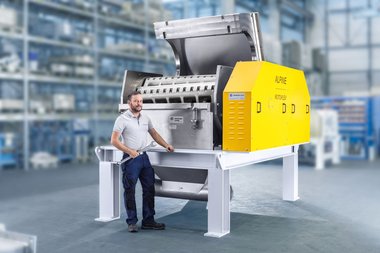
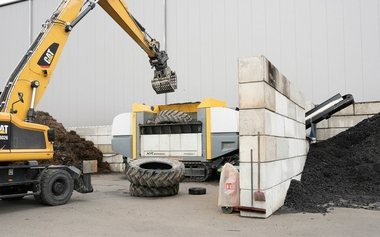
Textiles are generally designed for durability - cotton, blended fabrics, and synthetic fibers are often difficult to shred because they are fibrous and tear-resistant. This requires machines that can handle different material compositions as well as zippers, buttons, and other foreign materials. UNTHA‘s XR-class single-shaft shredders are up to the challenge, shredding approximately 6 – 10 t of textiles per hour. The C-cutting mechanism enables even particularly tear-resistant and elastic fabrics to be processed efficiently. Different perforated screens ensure a homogeneous output material of less than 30, 50, or 100 mm, depending on the requirements for substitute fuel. The narrow cutting gap ensures a precise cut and prevents material from wrapping around moving machine parts. In this application, the machine runs at up to 35 rpm, which means that foreign objects can also be processed without any problems.
For most companies, it is important that processing machines are energy-efficient and as quiet as possible. UNTHA shredders are very economical thanks to the UNTHA Eco Power Drive, and the slow-running drive also ensures low noise and dust emissions. In addition, the XR class models can be used for different material flows, giving operators a high degree of flexibility. Their robust construction and resistance to foreign objects make them ideal for multi-shift operation and ensure high machine availability.
4 Conclusion
Textile recycling is undergoing radical change – with new rules, ambitious targets, and high value-added potential. In order to recycle old clothes and textiles even more sensibly and sustainably in the future and to gradually reduce waste volumes, more conscious consumption and new recycling processes and technologies are needed.
UNTHA‘s shredding technology is a reliable partner for making EBS production from textiles even more efficient. This reduces waste volumes in the long term and makes more sensible use of resources.