

How BEWI closes the EPS loop
From post-consumer EPS to high-quality rGPPS at industrial scale 16.06.2026Shape, colour and quality of expanded polystyrene (EPS) can vary widely, which makes recycling challenging. However, this does not stop BEWI. The provider of packaging, components and insulation solutions has established one of Europe’s most advanced EPS recycling setups, processing nearly 40 000 t of post-consumer EPS each year. To handle the complexity of recycling EPS, BEWI relies on EREMA’s INTAREMA® TVEplus® technology.
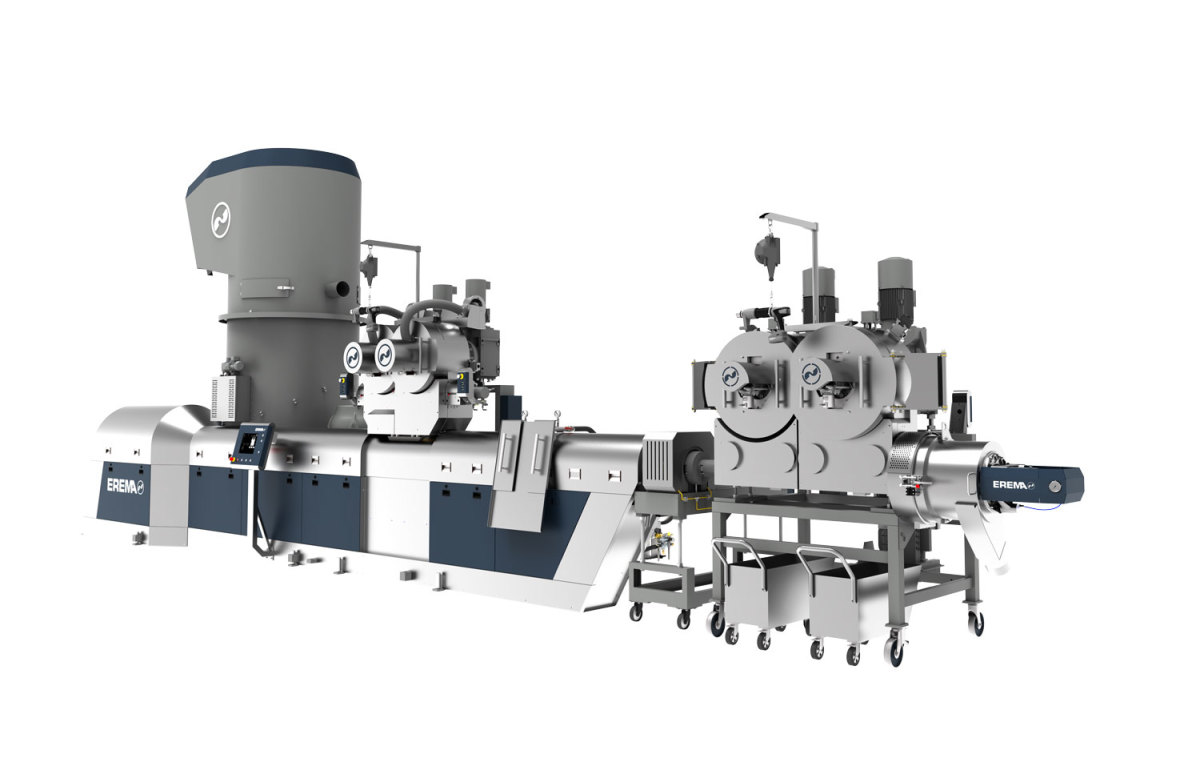
 EPS recycling at BEWI Circular: from post‑consumer input material to high‑quality rGPPS, processed using INTAREMA® TVEplus® technology
© BEWI Group
"EPS is a highly heterogeneous material with low bulk density, placing high demands on the extrusion process," explains Artem Ocheretin, Managing Director at BEWI Circular Czechia. "It differs in form, shape, colour, quality and moisture, and currently there is no feasible technology to wash or clean EPS in an economical way. As a result, the material places high demands on feeding stability, melt process and machine robustness."
Beyond robust recycling technology and reliable process stability, carefully selecting the input material is a key success factor for achieving rGPPS of consistently high quality at industrial scale. The pellets’ high quality is backed up by BEWI’s rigorous laboratory testing and quality control.
 © BEWI Group
Full throughput, even with fluctuating bulk density
"The recycling process begins with the input material being shredded and contamination, such as metal, being removed. The most important part is extrusion," explains Ocheretin. At the core of BEWI’s recycling process is EREMA’s INTAREMA® TVEplus® system, featuring the Preconditioning Unit (PCU) with patented Counter Current technology.
In the PCU, the material is gently prepared and homogenised before entering the extruder, stabilising material flow. Despite variations in bulk density, this system ensures stable operation and full throughput.
 © BEWI Group
High‑performance degassing and fine filtration
At the end of the plasticizing zone, the melt is cleaned in the fully automatic laser filter. "What we really appreciate about the EREMA Laserfilter is that it operates continuously with consistently stable pressure conditions," explains Ocheretin. "Thanks to its self‑cleaning design, filtration works reliably without downtime or manual intervention, which has a very positive impact on overall process stability." This combination of enhanced material intake, high‑performance degassing and fine filtration is crucial for producing rGPPS that meets BEWI’s quality requirements.
Long‑term reliability in technology and service
The sophisticated technology and the continuous development were decisive factors for BEWI. "The basic principle of TVEplus®, where melt filtration takes place upstream of extruder degassing, is crucial for processing EPS, " says Ocheretin. "We already had experience with EREMA technology and knew how the machines perform. Their reliability was a key reason why we decided on the INTAREMA® TVEplus® line. The strong service know-how, spare parts availability and the technical support we received over the years further reinforced that decision. "
A testament to the long‑term reliability of EREMA technology is the fact that BEWI still operates its first EREMA machine from 1995, which has been rebuilt and upgraded several times over the years.
Scaling high‑quality rGPPS production
By combining efficient recycling technology with a clear understanding of EPS material characteristics, BEWI Circular is able to process post‑consumer EPS reliably and at industrial scale. The resulting rGPPS is used in applications ranging from packaging and insulation to construction materials and transport solutions.
"As part of our commitment, we are dedicated to transforming EPS from a single-use material into a high-value resource designed for circularity," says Elin Sohlberg, Head of the recycling division at BEWI. According to BEWI, recycled or non‑fossil materials accounted for 34 % in 2025, providing a tangible indicator of its circularity ambitions. Looking ahead, the company plans to further expand its circular activities and continue developing applications for high‑quality rGPPS.