


Circular Valley Forum 2026
How the circular economy relates to responsibility and culture 20.10.2026Bishop Dr. Franz-Josef Overbeck and Japan’s Consul General Yoshitaka Tsunoda bring societal perspectives to the Circular Economy. Their keynote addresses build a bridge between responsibility for creation, structural change in the Ruhr region and Japan’s cultural understanding of valuing and appreciating things.
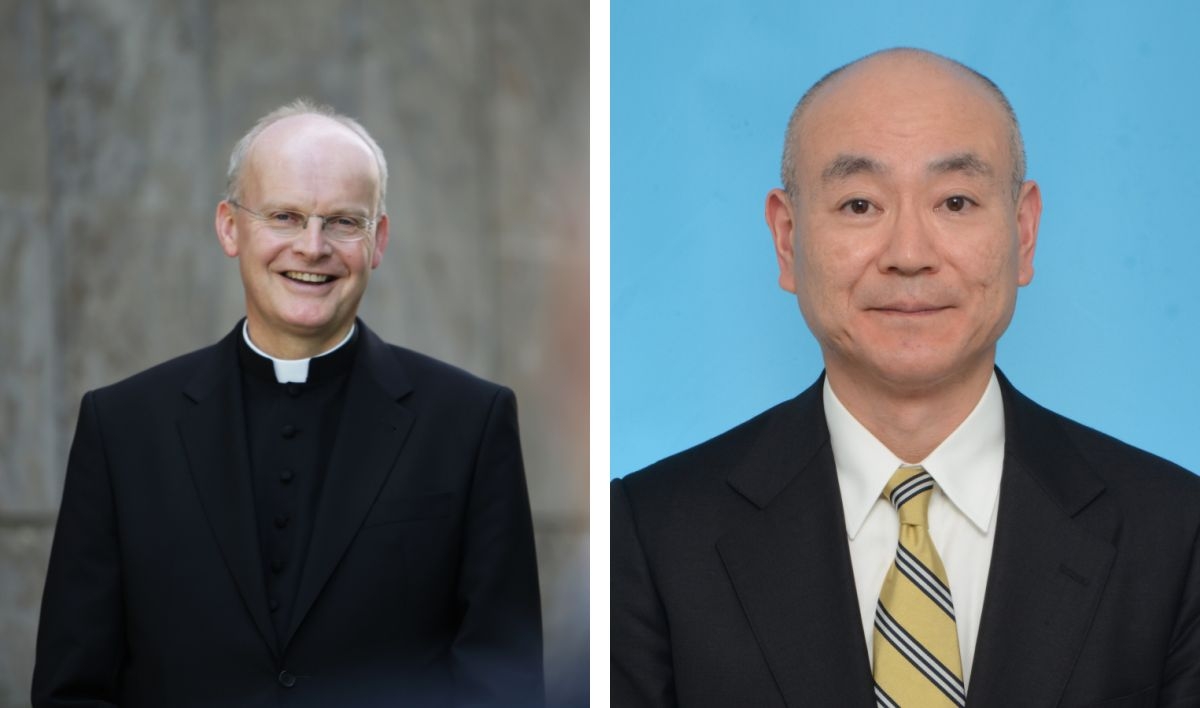 Bishop Franz-Josef Overbeck and Yoshitaka Tsunoda, Japan’s Consul General
© Nicole Cronauge / Bistum Essen (links) und Japanisches Generalkonsulat (rechts)
The circular economy is about more than technologies, business models and industrial value chains. It also raises fundamental questions: What responsibility do we bear for the natural resources and ecosystems on which we depend? How can economic transformation be shaped without losing sight of the people affected by it? And what can different cultures teach us about how we treat things and use resources? At the Circular Valley Forum on 13 November 2026 at the Historic Town Hall in Wuppertal, two speakers will bring these societal perspectives to the stage: one by Dr. theol. Franz-Josef Overbeck, Bishop of Essen and Bishop for the Ruhr region, and the other by Yoshitaka Tsunoda, Japan’s Consul General.
Under the motto “Circular Valley – Succeeding together”, the Circular Valley Foundation brings together leading figures from business, politics, science and society. While numerous contributions will demonstrate how companies and industries can close material loops and make circular business models economically successful, Dr. theol. Franz-Josef Overbeck and Yoshitaka Tsunoda will broaden the discussion to include the ethical foundations of the circular economy and the cultural values that can encourage a more conscious use of resources.
Responsibility for creation – and for an industrial region in transition
In his keynote, “Stewardship of Creation through a Circular Economy”, Dr. Franz-Josef Overbeck will address our responsibility to preserve creation. As Bishop for the Ruhr region, he brings this perspective to a region whose history and present are closely intertwined with industry. The transition away from coal and steel, the decline in industrial production and the search for new economic prospects have shaped the Ruhr region for decades.
Overbeck has been Bishop of Essen since 2009 and has accompanied key stages of this structural transformation. His perspective links responsibility for the environment and our natural foundations for life with the everyday realities of people whose work and future are closely tied to the region’s industrial development.
This is precisely where a particular connection to the circular economy emerges. By keeping materials in use for longer, recovering raw materials and closing material loops, a circular economy can also open up new prospects for industrial locations. It can help safeguard resources and create new directions for industrial value creation. For a region such as the Ruhr, the question is therefore not only how to close material loops from an environmental perspective, but also what economic and social future this can create for businesses, employees and the region as a whole.
“The Bishop brings together two perspectives that are equally important to the circular economy: responsibility for the preservation of creation and the everyday realities of people living in an industrial region. He is familiar with the far-reaching structural changes in the Ruhr region and understands what these changes mean for the people who live and work there. If we succeed in closing industrial loops here, this will also create new opportunities for the region,” says Dr. Carsten Gerhardt, Chairman of the Circular Valley Foundation.
“Leave a better place than you found it”: What Japan can teach us about valuing resources
Yoshitaka Tsunoda, Japan’s Consul General, offers a different perspective. His keynote is entitled “Leave a better place than you found it – Circular Economy in the Japanese Culture”. At its heart is the question of how cultural values shape our awareness of resources and what the circular economy can learn from them.
Japan and Germany have much in common. Both are highly developed industrial economies, have limited domestic raw material resources and face the challenge of maintaining their economic strength amid changing demographic and global conditions. This makes it particularly worthwhile to explore the differences between the two societies. Despite their many similarities, they have distinct cultural traditions when it comes to how things are treated, used and valued.
In Japan, the term “mottainai” expresses an attitude that rejects waste and emphasises appreciation for things and resources. What lies behind this attitude? What cultural experiences have shaped it? And what insights can it offer a society seeking to keep materials in use for as long as possible and avoid waste?
“As industrialised countries, Japan and Germany have much in common and face similar challenges. This makes it all the more interesting to look at one important difference: the cultural appreciation of things and attitudes towards waste. We can learn from this perspective. The circular economy needs not only new technologies and economic incentives, but also an awareness of the value of materials,” says Dr. Carsten Gerhardt.
Together, these contributions complement the Circular Valley Forum’s industrial discussions with two fundamental dimensions. Closed material loops do not emerge from technological innovation or new business models alone. They also require people to take responsibility, companies to align their decisions with long-term goals, and societies to recognise the value of their resources.