

One year after the rebuild at Reiling
 © Agentur wyynot, Jörg Liebig
 © Agentur wyynot, Jörg Liebig
 © Agentur wyynot, Jörg Liebig
 © Agentur wyynot, Jörg Liebig
 © Agentur wyynot, Jörg Liebig
 © Agentur wyynot, Jörg Liebig
 © Agentur wyynot, Jörg Liebig
The recycling company, Reiling GmbH & Co. KG and Swecon Baumaschinen GmbH show what’s behind the success of a rebuild measure at the Anröchte location and what’s making the project a prime example of efficiency, technology and sustainability.
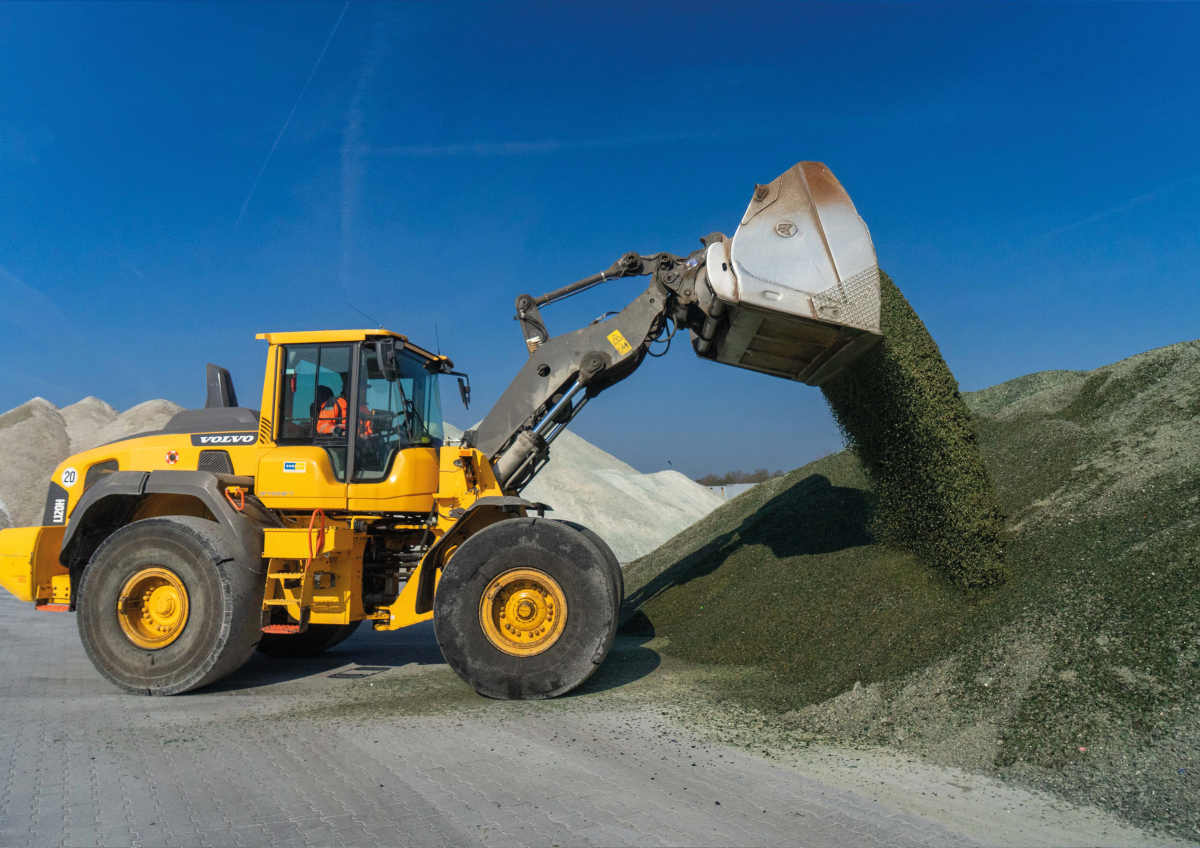
Heavy work in glass recycling: The Volvo L120H is again in the thick of it
In the Reiling GmbH & Co. KG glass recycling centre in Marienfeld, it gets down to business reliably every day: pushing glass waste piles together, filling processing plants, loading lorries – without a capable wheel loader, everything grinds to a halt. Among others, a Volvo L120H has been taking care of these key tasks for many years and does a great job under the abrasive conditions involved in glass handling. However, the machine had lost its shone over time – it was clear both technically and visibly: it’s time for a big decision.
But instead of procuring a new one, Reiling decided to take the sustainable route: the certified Volvo rebuild programme from Swecon. “Through sustainability, we wanted to save resources and give our machines a new lease of life,” explains Dirk Bessmann, deputy production manager at Reiling GmbH & Co. KG, about the objective on the customer side.
Thinking efficiently, acting sustainably
Reiling has been working closely with Swecon for many years when it comes to purchasing, servicing, maintaining and spare parts for the Volvo fleet. Among others, there are already two Volvo L120H wheel loaders and one Volvo L20 wheel loader in use in the Marienfeld location.
Swecon Customer Services Manager, Frank Schaefer and his team know the range of applications and the loading capacities of the L120H exactly, and knew: the machine’s core remains strong but wear and age point to the need for a comprehensive technical overhaul.
“We had clear expectations: we wanted the overhauled L120H to run like a new wheel loader again at the end. That was the requirement,” says Bessmann. It really paid off: significantly lower investment costs when compared to procuring new, lower costs per working hour and, at the same time, a clear signal when it comes to saving resources and recycling economy – an approach that fits a recycling company such as Reiling perfectly.
Eight weeks, 550 parts: the first rebuild in Anröchte
The Reiling Volvo L120H was the first certified rebuild project for the Swecon location in Anröchte and was therefore a real endurance test for the team. “It was really exciting to dismantle the wheel loader completely and then to rebuild it from scratch,” reports Christian Spieth, the rebuild fitter responsible at Swecon Baumaschinen GmbH. “For eight weeks, two experienced colleagues and I were working on the wheel loader almost exclusively – from initial disassembly to the final functional test.”
The scale was accordingly large: “We replaced all wiring harnesses on the wheel loader, overhauled the hydraulic cylinders, completely refurbished the axles and installed the engine and gearbox as new components,” Spieth recalls. Around 550 listed original parts were replaced in total. There was also an overhauled cooler unit, the hydraulic hose lines were replaced and the boom received new bushings including new pins. “A huge benefit was that all central main components could be retained: the hydraulic cylinders were as good as new after the overhaul. The chassis, the boom and the axles were able to be fully reused after the general refurbishment,” says Spieth.
In addition to the technical challenges, the project’s process structure was also key to the success: “This was our first Volvo rebuild at this location and was a real challenge for all involved. We planned precisely which components had to be ordered and installed, and in which order in order to keep everything within the specified schedule. I’m really proud of what the team achieved together during this rebuild project”, summarises Spieth.
Like a new wheel loader – including service and guarantee
After the general refurbishment and installing all new components, the Volvo L120H was equipped with the latest technical specifications that also apply to the current series. When it comes to capability, efficiency and equipment, the wheel loader is comparable to a new machine from both a visual and technical point of view. Comprehensive functional tests and the handover to the Reiling team, complete with training, completed the rebuild process.
There are no trade-offs for the customer when it comes to guarantee and service either: “After completing a Volvo rebuild, the customers receive the same guarantee on the work performed as they would if a new machine were delivered. Furthermore, our customers can conclude further individual maintenance and repair contracts,” mentions Spieth. Swecon’s Volvo rebuild concept therefore does not just provide its customers with an investment alternative, but also with the well-known safety for ongoing operation.
Practical test passed: 3000 h in
glass handling
Almost a year after returning to Marienfeld, the overhauled Volvo L120H has already completed around 3000 working hours in glass recycling – it‘s in use daily when piling up the glass mountains, loading the lorries and filling the treatment plants and crushing units. The conclusion is clear: “After 3000 working hours, we can clearly say: It was the right decision for us. The machine is running as well as on its first day, exactly as we expected from our partner Swecon,” summarises Bessmann.
Faults or unplanned downtimes haven’t been an issue up to now. The operators confirm that the wheel loader drives like a new machine. For Reiling, this confirms the underlying decision to rely on a Volvo rebuild, economically efficient, technically convincing and in the best interests of sustainability – because existing resources are used and the machine service life is extended significantly.
Ready for the next second life
The rebuild of the Reiling L120H was an important milestone for Swecon Anröchte. “Following advance checks, it can be applied to almost any older Volvo machine. Our team at the Anröchte location if definitely ready for upcoming rebuild projects,” says Spieth. The combination of a certified process, a well-rehearsed team and a concrete reference in glass recycling applications shows the potential of the “second machine life” concept.
Reiling is also thinking further: “We already have some ideas of which Volvo machines we could also have overhauled by the rebuild programme,” says Bessmann, looking to the future. What started in glass recycling in Marienfeld could therefore become the prototype for other locations and industries – wherever sustainability is par for the course not just when it comes to the material but also to the machines used.