

“In recycling, what counts is robust technology that works reliably every day”
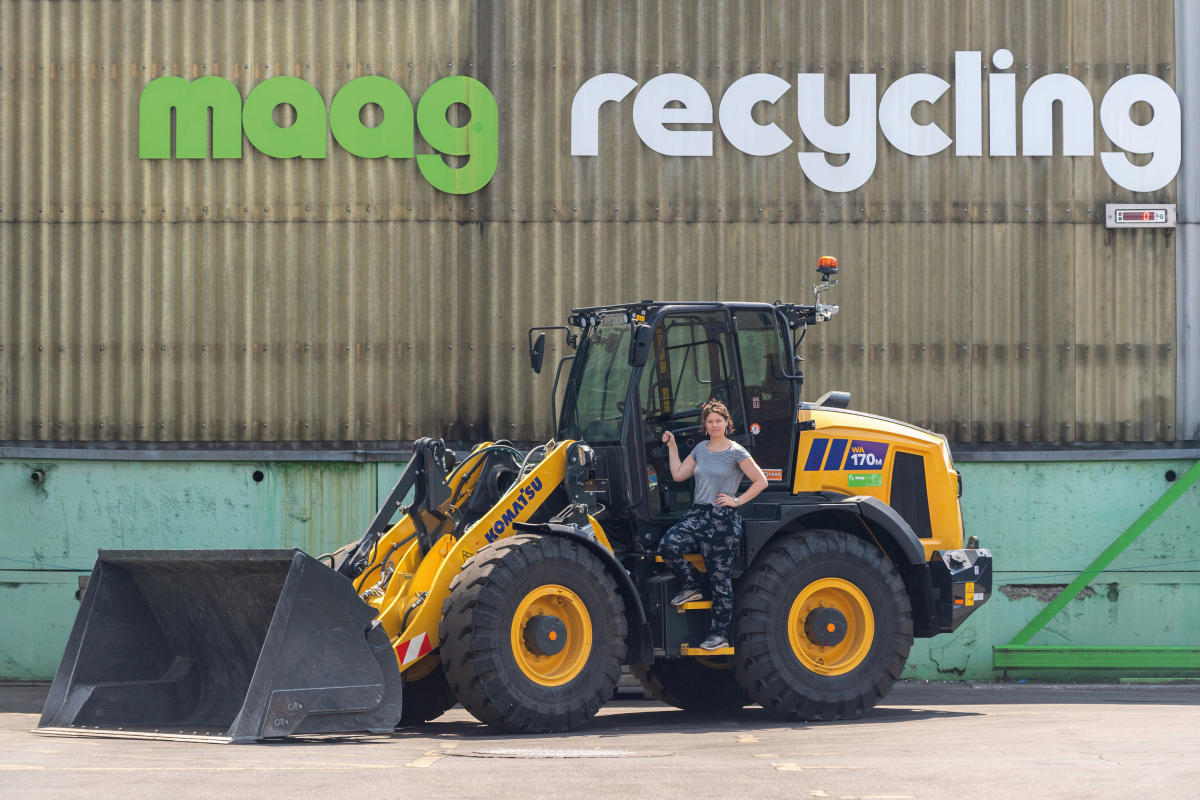


In this interview, Judith Maag, Managing Director of Maag Recycling AG in Winterthur, discusses the demands placed on modern recycling plants and the use of a new Komatsu machine in the challenging day-to-day operations involving scrap, glass, paper and metal.
Anyone stepping onto the premises of Maag Recycling AG in Winterthur immediately realizes that recycling here is not an abstract concept, but rather a daily task requiring precision. For around 80 years, Maag Recycling AG has been synonymous with industrial recycling expertise in Switzerland. At its site in Winterthur, the family-run business processes metals, scrap, glass, paper and cardboard, amongst other materials. In this interview, Managing Director Judith Maag explains the challenges facing the business, what is particularly important when it comes to machinery in recycling, and why robust, user-friendly technology is crucial in day-to-day operations.
The machine in use is the Komatsu WA170M-11, a compact wheel loader in the 10 t class. The model was developed for versatile construction, industrial and recycling applications and combines compact dimensions with high performance and flexible operational capabilities. With an engine power of around 96 kW, an operating weight of approximately 9.6 - 10.6 t and a bucket capacity of 1.5 - 1.7 m3, the WA170M-11 is designed for productive work in confined and demanding conditions. Particularly relevant for day-to-day recycling work are its manoeuvrability, robust design, good visibility from the cab, the reversing camera and easy access for maintenance via the tilting cab and bonnet. Depending on the specification, the machine can be adapted to various attachments and operational profiles using different boom options and auxiliary hydraulic circuits.
During the interview, it wasn’t just Managing Director Judith Maag and the business perspective on the recycling operation that were highlighted. Questions about the machine itself were also discussed directly with the two operators, Viktoria Repova and Tania Pianese, who operate the WA170M-11 on a daily basis. The visit thus also paints a remarkable picture of a modern recycling plant: at Maag Recycling, women are naturally given the opportunity to demonstrate their expertise in an industry traditionally dominated by men. Viktoria Repova and Tania Pianese are not exceptions within the company, but rather professionally recognised machine operators with a solid standing – underpinned by experience, skill and excellent operational competence.
Mrs Maag, could you briefly introduce Maag Recycling AG?
Judith Maag: Maag Recycling AG is a long-established family business now in its fourth generation. We have been active in recycling for around 80 years, specialising in industrial recycling and the processing of scrap, metals, glass, paper and cardboard. In addition, we operate an electronics dismantling facility and a recycling centre for private individuals. We currently employ around 70 staff. Another key focus for us is our work on inclusion, for which our company has already received awards. We offer career prospects to people with physical or mental health conditions.
Which materials are the main focus of your operations?
Judith Maag: Our material flow is very diverse. Among other things, we process paper, glass, cardboard, metals, scrap and aluminium cans. It is precisely this diversity that makes the operation exciting, but also challenging. Essentially, we need machines that can reliably handle a wide variety of tasks – in other words, the proverbial "jack of all trades".
What are the biggest challenges in day-to-day recycling operations?
Judith Maag: We work in a confined space with many different material fractions. At the same time, the demands are increasing – both in terms of processing and handling the various material compositions. Added to this are pollutants and hazardous substances that aren’t always immediately recognisable. Our staff work outdoors in all weathers, loading railway wagons and lorries, and have to react flexibly to incoming materials.
Where do technology and processes reach their limits in this context?
Judith Maag: Recycling is a real endurance test for machinery. We have to deal with abrasive material, dust, heat, cold, sharp edges and glass dust. At the same time, the process cannot always be planned precisely: the material arrives when it arrives. Unloading slots are simply not feasible, and the pace is often dictated by external factors – such as suppliers, customers or regulatory requirements.
What role do efficiency and productivity play?
Judith Maag: A very significant role. For us, it’s crucial that machines have as little unplanned downtime as possible. They must be economical, yet powerful enough to reliably move large volumes of material. Unplanned downtime is particularly problematic in recycling operations because it has an immediate impact on processes.
What do you generally expect from modern construction machinery in recycling?
Viktoria Repova: Reliability, user-friendliness and robust technology. A machine must be suited to the job and built to last. It is important to us that it is not overloaded with unnecessary functions. Too many "bells and whistles" or too many sensors can also be additional sources of error in the harsh day-to-day environment. The key thing is that the technology works and supports the people on site.
How long have you been using the new machine?
Viktoria Repova: We’ve been using the Komatsu WA170M-11 wheel loader since June 2026. It’s mainly used in paper and glass recycling, as well as for scrap handling and handling tins.
How does the machine support you in your day-to-day work?
Viktoria Repova: It responds quickly, is powerful and is manoeuvrable and agile in operation. This is important to us because space is limited on site and many manoeuvres have to be carried out with precision. When materials are delivered, lorries are manoeuvring and railway wagons are being loaded at the same time, every safe manoeuvre counts. Another particularly important factor is the loading height: with this machine, we can reach the height of railway wagons – around 4.10 m. This significantly expands the range of applications in day-to-day operations.
How do your staff rate the machine?
Judith Maag: It’s intuitive to operate. We’ve incorporated a lot of new technology into the machine, but with this model, we’ve struck exactly the right balance between innovation and ease of use. It isn’t overloaded with features, and you get used to it quickly. This is particularly important because we have frequent driver changes and not every driver operates this machine on a daily basis.
Which aspects stand out in terms of comfort and safety?
Viktoria Repova: The camera is very useful and provides a clear picture. This helps to improve safety on the depot. In our view, the field of view could be a little wider, but fundamentally it’s a significant improvement and a clear advantage. The air conditioning, especially in temperatures like today’s of around 30 degrees, and compatibility with our Freund high-tipping bucket are also important factors for day-to-day use.
Were there any details that pleasantly surprised you?
Viktoria Repova: Yes, for example, the bonnet, which opens backwards and upwards. The spring-assisted mechanism makes this easy, and the maintenance access points are conveniently located. We were also very impressed with the induction and training on the new machine. This makes it much easier to introduce it into our operations.
Would you recommend the WA170M-11?
Viktoria Repova: Yes, because it’s very well suited to our needs. The size is just right for the conditions here on site; it’s designed for industrial applications and is also economically attractive. Also important to us were the easy access to a nearby service centre and the excellent advice – not just during the sales process, but also on technical matters. Another decisive factor for us is that the machine is developed and manufactured in Europe. The factory visit to Hanover beforehand, the opportunity to test the machine ourselves there, and the insight into the manufacturing process all helped to build trust.
If you had to describe the machine in one sentence – what would it be?
Viktoria Repova: Robust technology that works reliably in the demanding day-to-day reality of recycling and supports our operations where it really counts.