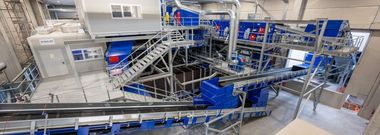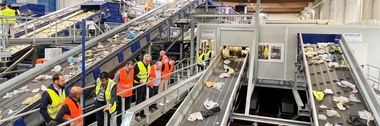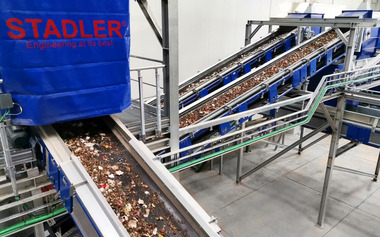


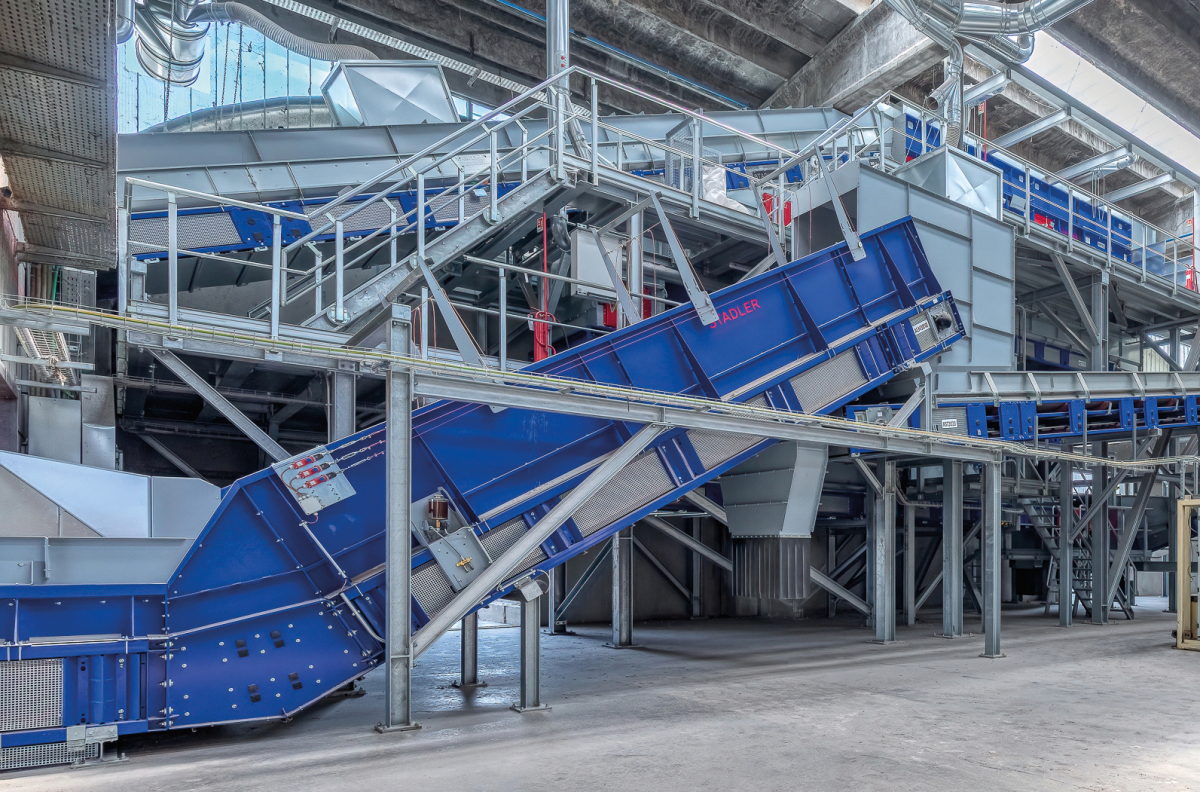
High-performance paper and cardboard sorting plant in Collegno/Italy
 © STADLER Anlagenbau GmbH
 © STADLER Anlagenbau GmbH
 © STADLER Anlagenbau GmbH
 © STADLER Anlagenbau GmbH
 © STADLER Anlagenbau GmbH
 © STADLER Anlagenbau GmbH
The new plant is the first in Italy capable of separating six different types of paper and cardboard. Designed for flexibility, high throughput, and precision, it brings together the engineering expertise of STADLER Anlagenbau GmbH and Pellenc ST’s latest AI-powered optical sorting technology, fulfilling the ambitious sustainability and operational goals of multi-utility company Iren SpA.
STADLER has completed a new high-performance paper and cardboard sorting facility for Italian multi-utility company Iren in Collegno, in the Turin area. Built in partnership with Pellenc ST, a leader in intelligent sorting equipment, the facility marks a major step forward in Turin’s circular economy infrastructure.
The plant, which has a capacity of 8 t/h, is the first of its kind capable of sorting six different types of paper products, including multilayer materials. Its innovative layout, compact design, and advanced automation meet Iren’s demand for operational flexibility, capacity, reliability, and quality output, delivering a solution adapted to both current and future requirements.
“We are proud to continue our longstanding partnership with Iren through this new project in Collegno,” says Paolo Cravedi, Senior Project Manager at STADLER. “This plant is the result of close collaboration and shared commitment to sustainability, technical innovation and performance.”
A new benchmark in paper sorting: six output streams and AI-driven performance
The Collegno plant stands out as a technological milestone in paper and cardboard recycling. It is the first facility to separate six different types of paper-based output materials within a single sorting line: large cardboard, deinking paper, white paper, fine paper, multilayer material with aluminium, and multilayer without aluminium.
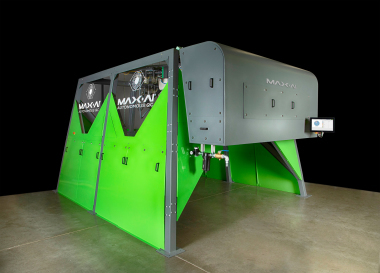
The process starts with dosing and mechanical separation using STADLER’s double-deck PPK2000 and STT2000 ballistic separators, which sort out large cardboard and fine material, respectively. Medium-sized material, containing various types of paper, then progresses to six Pellenc ST COMPACT+™ optical sorters that utilise Near Infrared (NIR) and visible spectroscopy and are equipped with CNS BRAIN™, the company’s latest AI integrated software, to identify the different types of paper.
“CNS BRAIN™ enables us to tackle new use cases in the sorting of fibrous materials, particularly in distinguishing between white paper and white cardboard, which are visually similar but differ in value,” explains Matteo Loiacono, Sales Manager Italy at Pellenc ST. “This AI-powered system plugs directly into our optical sorters without additional infrastructure or energy consumption, offering a powerful, robust and efficient solution.”
Each fraction undergoes a manual quality control and automatic composition analysis before being baled and stored. The system also includes direct bypasses and flexible feeding options to accommodate variations in input and demand, aligning the plant’s design with the evolving dynamics of the recovered paper market.
Smart design and precise execution in a compact space
One of the major challenges of the Collegno project was to build the new plant within the confines of an existing building. STADLER completed the dismantling of the old facility in just three weeks, followed by a three-month mechanical assembly, two-month electrical installation, and one-month commissioning – all delivered on schedule.
“Adapting the new plant to the pre-existing building layout and electrical infrastructure was a significant challenge,” explains Paolo Cravedi. “We had to rework the layout, particularly in the feeding area and the baler positioning, to optimise space use and ensure efficient material handling. The end result is a flexible, compact and efficient plant that meets today’s requirements and is ready for tomorrow’s challenges.”
Damiano Giovanardi, Project Manager at Iren, adds: “During the design phase, it became necessary to enhance the line’s separation capacity. STADLER and Pellenc ST were highly responsive and accommodated all our requests by adapting the layout to guarantee the best sorting performance.”
Iren commended STADLER’s performance not only for its engineering but also for its professionalism during site works: “From dismantling to commissioning, STADLER followed strict safety protocols and kept the site clean and well-organised,” says Damiano Giovanardi. “They were precise and punctual, meeting all deadlines in our agreed timetable, and completing the plant start-up and performance tests in just four weeks. During the same period, they also provided exhaustive training so that our operators could immediately take over the plant after commissioning.”
Combining STADLER’s engineering with Pellenc ST’s advanced optical sorting for optimal results
The success of the Collegno project is the latest outcome of a solid collaboration between Iren, STADLER and Pellenc ST. For Iren, it builds on a long series of partnerships with STADLER, which began in 2020 and include facilities in Piacenza, Volpiano, Pianezza, Parma, Asti, and the landmark Circular Plastic plant in Borgaro – Italy’s most advanced plastic sorting facility.
“Worldwide, Pellenc ST has been working with STADLER for many years,” notes Matteo Loiacono. “This has enabled us to establish a strong relationship based on trust and mutual understanding, resulting in shorter commissioning times. For Collegno, STADLER optimised the integration of peripherals and the airflow dynamics system. Combined with our optical sorters, this partnership achieved the best sorting performance on the market while maintaining high throughputs, exceeding the customer’s initial targets.”
Advancing the circular economy
The new Collegno sorting facility is a strategic asset in the waste management for the Turin metropolitan area. “This plant completes Turin’s separate waste collection treatment scheme,” says Damiano Giovanardi. “After the Pianezza facility, which serves as a district centre for plastics, and the Borgaro plant, a secondary plastics sorting centre, we now have a high-performance paper and cardboard plant that fills the final gap left by the previous plant.”
The new plant ensures the efficient treatment of a growing stream of paper and cardboard, made more complex by shifts in consumer behaviour, such as the increase in e-commerce packaging and the decline in printed media. “The volume of brown cardboard has risen sharply, while the tonnage of newspapers and magazines is dropping,” explains Matteo Loiacono. “This means that the challenge is to maximise the yield of higher-value fractions such as office paper, and not confuse them with white cardboard. Our AI-powered optical sorters can handle the most complex sorting tasks, like separating white cardboard from white paper.”
By separating six distinct fractions, the plant allows for better marketability of materials and differentiated pricing, which supports the economic sustainability of local recycling efforts. “The plant’s standout feature is its flexibility, which ensures we can adapt to market demands and future needs,” concludes Damiano Giovanardi. “Together with the high reliability and availability of the line, this guarantees excellent production results over the long term.”