

Fraunhofer UMSICHT
More sustainable production in the metalworking and chemical industriesAdvancing the circular economy in the metalworking and chemical industries – that is the goal of the “SäureWert” research project. Recovering acids and valuable resources reduces the demand for primary raw materials and the volume of hazardous waste. This conserves resources, cuts costs, and reduces environmental impact. Fraunhofer UMSICHT, together with project partner FNE Entsorgungsdienste Freiberg GmbH, is paving the way for industrial application.
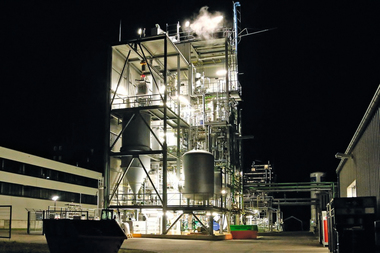
 Process development and technical implementation at the Fraunhofer UMSICHT
© Fraunhofer UMSICHT
Alongside petroleum byproducts, acids are the most important commodities in the manufacturing industry. They are indispensable, for example, in metalworking facilities, where they ensure the surface quality and durability of metal products in pickling solutions. In Germany alone, 2.83 million tons of sulfuric acid and 1.53 million tons of hydrochloric acid were produced in 2023 (German Chemical Industry Association – VCI: The Chemical Industry in Figures, 2024 Edition. Frankfurt a. M.) – equivalent to a good 34 kg per capita. “An enormous amount that entails high follow-up costs due to the resulting waste streams,” notes Lukas Rüller of the Fraunhofer Institute for Environmental, Safety, and Energy Technology UMSICHT. After use, the acids are classified as contaminated hazardous waste: they must be neutralized and disposed of, resulting in sludge and hazardous waste. At the same time, valuable metals or rare earth elements are lost – and with them, important raw materials for industry.
 Recovered process streams such as hydrochloric and sulfuric acid, as well as valuable materials such as chromium nitrate and copper sulfate
© Fraunhofer UMSICHT/AI-generated
Membranes withstand extreme process conditions
Fraunhofer UMSICHT aims to return so-called waste acids to the process cycle and selectively separate valuable materials. As part of the “SäureWert” project, the Oberhausen-based research institute is collaborating with project partner FNE to develop a continuously operated process combining nanofiltration with subsequent concentrate treatment. The process utilizes novel, highly acid-resistant membranes that can withstand even extreme process conditions – pH, temperature, and pressure. The waste acids are purified using special filters so that the dissolved valuable materials remain on the membrane side. A controlled residence time of the solution in the membrane system prevents crystals from forming in the membrane. Blockages and thus downtime are avoided.
Benefits for the environment and the company
The result is, on the one hand, reusable acids and, on the other, raw materials separated through further process steps such as crystallization or precipitation. Lukas Rüller: “When acids and metals remain in the cycle, both companies and the environment benefit equally. And we are taking an important step toward a true circular economy.”
The project is scheduled to last two years. First, the researchers will test suitable membranes and adjust the process parameters. In a second phase, a pilot plant will be built at FNE in Freiberg and tested in operation. At the same time, the project team is holding discussions with potential customers to identify further use cases and develop business models.
Hall B2, Booth 115